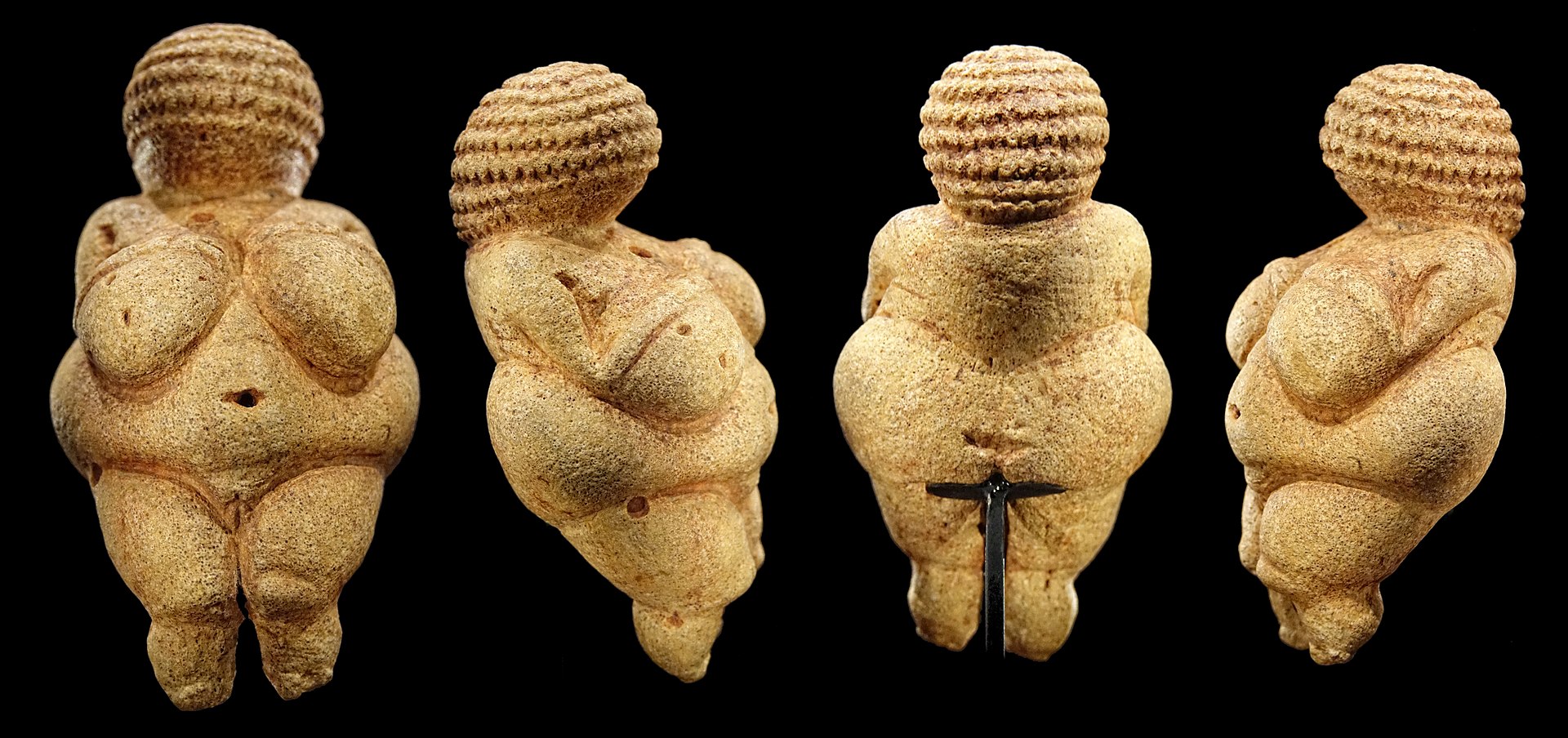
This is the Venus of Willendorf, a statuette of a large female figure dating back to 25,000 BCE. This figurine is not unique; primordial images of obese people as symbols of fertility, beauty and worship can be found all around the world. It’s not clear whether these were mere symbols, or real people, but it’s clear that in certain ancient cultures, obesity was something to behold.
It wasn’t long until obesity became associated with negative health. The ancient greek physician, Hippocrates wrote about the negative effects of obesity way back in 500 BCE and the Bible similarly took a harsh attitude towards overeating after gluttony was canonized as one of the Seven Deadly Sins. But this didn’t stop obesity from being seen as a positive in cultures around the world. Fattening has been used as a practice everywhere from Afghanistan to Tahiti to make young men and women ready for marriage, and the famous 17th century artist Peter Paul Rubens painted beautiful and fat depictions of mythological goddesses.
The history of obesity is long and complicated, with varying degrees of positive and negative representation. But to understand the modern reaction to obesity, it’s useful to look at the relationship obesity has with its’ counterpart: undernutrition.
During the Industrial Revolution, adult stature in the UK declined dramatically. New technologies and political developments led to the creation of a new class of people who worked in dangerous factories and packed into overcrowded cities with little access to quality food leading to widespread malnutrition.
The pace of industrialization levelled out by the 19th century as there was generally enough factories and labor to meet demand. But this created a problem for businesses: the market was just too small. They had the capacity to produce more and more, but not the demand to meet it. How do you solve this? Easy! You expand the market! First, they expanded the market domestically by slowly increasing wages to promote consumption within the working class. This allowed adult stature to recover after the initial dip as workers gained more consistent access to higher nutrition foods and the goods they themselves produced. Secondly, the British Empire forced its way into overseas markets like India, where they destroyed local industries and forced the local populations to export goods back to the UK. Before being colonized, India had the largest economy in the world while Britain held a mere 3% of the global output. After being ransacked, India’s economy dipped and experienced a series of disastrous famines. Indian male height fell at a rate of 1.8cm per century while British incomes rose to six times that of Indian workers.
This is the push-pull dynamic that we’re going to see again and again. Undernutrition on one side and overnutrition on the other.
Colonial expansion was a global process that created a worldwide network of exploitation. As colonized countries became export economies, sending their foods and goods abroad, their workers faced major food insecurity. As colonizer countries saw vast increases in wealth, their workers slowly went from being producers involved in the production of food to consumers. And as we became consumers, we got a little thicker.
It’s no coincidence that the 19th century is also the one that marks the origins of modern dieting. William Banting, a formerly obese undertaker, wrote the first modern diet in which he described a diet resembling keto. By the turn of the century, dozens of diet books had been published as Victorian fascination with slimness grew.
The changing standard of beauty was especially harsh on women. One Victorian woman wrote, “Alas for the fat one! She gets into clothes that are skintight, and she draws in her corset string until it snaps and gives at every breath and sneeze, and even then she does not look graceful and pretty, for the fat—like secrets—will out, and it rolls over and around like the little bumps and humps in a pudding bag.” Obese people found themselves the subjects of mockery, whether it was in Shakespearan plays, or as objects of fascination in circus freak shows.
By the 1920’s, the Flapper girls’ thin and flat physique had become the standard to strive for. The look was promoted in print advertisements, and young women sought out all kinds of fad diets and cosmetics to achieve the look. And even though beauty standards continued to change from the 1940’s onward, one standard remained constant: don’t. be. fat.
While beauty standards continued developing, the end of World War 2 ushered in a new era of decolonization in the world, disrupting the state-sponsored exploitation of the centuries prior. But this didn’t mean the cycle of undernutrition and overnutrition had ended. The global economy only found new enforcement mechanisms. Take for example, the loans issued to formerly colonized nations by the International Monetary Fund. These came packaged with programs that opened up their economies to foreign investment to help stimulate their economy. Despite this supposed aid, these programs have been linked to widespread malnutrition and famine deaths in countries all over Africa and South America, mimicking the colonial process of over-and-undernutrition with a fresh coat of paint.
While industrialized nations profited handsomely off these policies and workers in these nations enjoyed an explosion in consumer buying power, the food they had access to also became worse through the increasingly complex global food business.
A 2012 study on the links between global capitalism and obesity outlines how this worked. “For example, the boom in soy agriculture in Brazil contributed to cheaper and faster livestock-raising in the US, processes that decreased the cost of US meat whilst also raising its fat content, though contributing to under-nutrition in Brazil through increases in local food prices.” Another example of this is in the production of coffee. The world drinks over 2.25 billions cups of coffee a day, but coffee is a very labor-intensive crop. Plantation workers across the world face severe malnourishment due to their miniscule wages and their malnourishment feeds the global food industry, both in direct ways like making its way into your sugary, calorie-dense Starbucks drinks, but also in indirect ways. Coffee is a common additive in soft drinks, making them easier and more addictive to consume. And to top it off, coffee is commonly marketed as an easy way to boost productivity and change consumer behaviors in the same emerging markets they’re harvested from, fully completing the cycle.
This increase in cheap, processed foods, was a change that coincided with the rise of supermarkets and mass advertising, compelling Western consumers to consume at an ever-increasing rate all while mistreating the larger members of it’s society. This was a bubble ready to burst.
The 1960’s saw a wave of massive, global uprisings, that saw students and workers erupting in protest against white supremacy, patriarchy, LGBT discrimination, capitalism, whatever permutation of exploitation you can find, the 1960’s rebelled against it. And fat discrimination was no different. It all started with the 1967 fat-in in New York’s Central Park. The fat-in consisted of 500 people marching, eating and burning dieting books and pictures of the British model, Twiggy. Two years later, the National Association to Advance Fat Acceptance, or NAAFA, was founded, dedicated to improving the quality of life for fat people everywhere. Shortly after its founding, a radical sect of the group spun off, calling themselves the Fat Underground. Claiming that doctors were part of a cabal trying to commit genocide against fat people, the group was tiny, and aside from a few small actions, they quickly fizzled out.
This was the first wave of fat activism. And regardless of what you think of fat activism today, I think it’s hard to claim that the movement at large didn’t have a valid point. Obese people face a neverending torrent of micro and macroaggressions from the people around them. Obesity should be a conversation people have with their doctors, not nosey friends and relatives. And when it comes to the workplace, it’s even worse. The majority of employers would choose applicants with a normal weight over equally-qualified obese candidates. And since weight isn’t a protected class, this is 100% legal.
Even the more radical fat activists kind of had a point. It’s hard to separate diet culture, with the world’s thousand-year long history of controlling women’s bodies. When you look at the grand scheme, it sure looks like the “War on Obesity'' is just another lever used to enforce patriarchy.
So I think saying, fuck it, fuck your beauty standards and choosing to fight fat discrimination and promoting a good quality of life for fat people is a noble goal. And most Americans would agree, at least partly. For example, public support for laws to limit weight discriminaton in the workplace is at an all-time high. And according to a YouGov poll, the majority of Americans familiar with the body positivity movement tend to believe it’s a good thing for society.
But, the fat activism of the 1970’s is far removed from the fat activism of 2021. By the 70’s the obesity epidemic hadn't even started yet. BMI *is* slowly increasing around this time, but the epidemic proper won't start until 20 years from now. So what happened in the 1990’s that catapulted us into this?
American anthropologist Sidney Wilfred Mintz argues that a key element of the changing global order during the 20th century was a loss of individual agency. Which might sound a little conspiratorial, but according to this argument, “commercial organizations have collectively learned to maximize profits through “making consumers” decisions for them. Such decisions are “made” both at the behavioral level, through advertising, price manipulations and restriction of choice, and at the physiological level through the enhancement of addictive properties of foods.”
Nothing makes a better case-study of this than Mexico’s relationship with food. As of 2008, Mexico trumped the United States in adult obesity rates. It’s no coincidence that this occurred a mere 14 years after the North American Free Trade Agreement, went into effect. After the deal was signed, Mexican markets were flooded with US corn and soy products. The number of distinct local breeds of maize that had been maintained by rural communities throughout the nation fell to the cheap, monocultural corn of the north, creating mass displacement in small and indigenous farming communities and a rising poverty rate. Does this story sound familiar?
Unlike India in the 19th century, Mexicans didn’t suffer from undernutrition, instead, cheap processed foods became commonplace in Mexican markets and households. With products like Coke being so readily available that it was cheaper and more common than water. Today one in four children in Mexico are overweight, with the number jumping to one in three for teenagers.
Borrowing from Mintz’ analysis, it’s easy to explain why this happened. At a macro level, our consumption habits are shaped by what’s easiest, cheapest and most available. And these are all determined by multi-billion dollar industries and state power far beyond any of our control. By prying open the gates of foreign markets, agribusiness has been able to destabilize foreign economies and cause obesity epidemics practically overnight.
This loss of agency is at the heart of the issue. But it’s not something you hear very often in mainstream discussions on obesity. Instead, most outlets tend to *highlight* our agency. The argument goes that it’s the rise of cars, desk jobs, new forms of entertainment and fast food joints that are causing the obesity epidemic. We’ve transitioned to a sedentary race of people, and so the antidote to obesity is usually choosing to walk more, buying a standing desk, parking a little bit farther from the store, and, of course, eating healthier. When individual actions are both the problem and the solution, it obfuscates the political nature of the question, it prevents us from pursuing the practical laws we can implement to stop it, AND it opens a new market for the emerging industry ready to sell you silver bullet solutions.
The dieting and fitness industry has grown steadily since the 19th century. It’s estimated that the industry generates almost 100 billion dollars in revenue every year and it’s not hard to see how. We’re simultaneously conditioned to crave foods that make us overweight and to crave either rail-thin or super heroic figures, which has created a cascade of body image and health issues. Yo-yo dieting, or losing and then regaining weight over and over, has been associated with increased risk of heart disease. Eating disorders like anorexia and bulimia have increased dramatically since the 20th century, especially affecting young girls, and the use of performance-enhancing drugs in boys is a hidden, yet serious issue. Kids younger and younger are dieting as a direct result from the pressures of society to conform to weight standards.
What a time we live in, right? We generate enough food to feed 10 billion people, and while people in the global core feed themselves to death, it’s estimated that over 200 million people suffer severe hunger in Africa, moderate food insecurity affects a third of people in Latin America, and half a billion people are undernourished in Asia. Having a fit and healthy body has become a class issue. In countries like the United States, individuals living in the poorest communities are the most susceptible to obesity.
This is a strange paradox. How can you be both poor and fat? This reality has lent credence to people who claim that global poverty isn’t really that bad. I mean, if you can afford to be fat you can’t be that poor! So let’s untangle the paradox. It starts to make sense once we reframe the issue, not as a question of under or overnutrition, but as one of malnutrition. Obesity, just like being underweight, is a state of malnutrition. And malnourishment is a condition the working class has long grown used to.
Just like in the era of colonization, this malnourishment is a result of the way businesses have dealt with limits of the market. By the end of the 20th century, agribusiness had developed a production capacity so large it could end world hunger overnight and still have a surplus. But again, there’s the issue of the market size that limits how much of that can actually be consumed for a profit. Unless, you store that surplus in our bodies. Obesity is the solution to the limits of the market, achieving forever growing profits by exploiting our bodies expanding them to ravenous proportions.
All of these factors I’ve outlined have created a disaster. As of 2016, almost 2 billion people were overweight, with 650 million of them being obese. Related conditions such as heart disease, stroke, type 2 diabetes and certain types of cancers have become the leading cause of preventable, premature death. And today, most of the world’s population live in countries where being overweight is a bigger cause of death than being underweight.
These numbers are devastating. But there’s a lot of things we can do. Agribusiness has been allowed to unleash an unprecedented level of harm because they’re socializing the effects of their destruction. They don’t have to pay for our health bill. But, what if they did? By taxing them based on the level of unhealthy food they sell and diverting that to health care, banning certain food products, focusing on local food distribution chains so we don’t have to add junk additives and preservatives to make food last a million years. These are all simple, common sense solutions to the obesity epidemic. And that’s why instead of this we get bullshit like Michelle Obama’s “Let’s Move” campaign focused on getting kids to live more healthy and active lifestyles. It’s like fighting climate change by creating a recycling program, it’s just not getting to the root of the problem. Of course, that’s by design when the government serves the interests of corporations, but this isn’t the video for that.
But where obesity differs from something like climate change is that, the only person who determines what you put in your body is… you. While no matter how much you reduce your carbon footprint, the environment will continue to be destroyed, changing your food and health habits WILL let you change YOUR body.
But not everyone agrees with this sentiment.
“We’ve lost the war on obesity. Fighting fat hasn’t made the fat go away. And being thinner, even if we knew how to successfully accomplish it, will not necessarily make us healthier or happier. The war on obesity has taken its toll.
Health at Every Size is the new peace movement. It helps us recognize that health outcomes are primarily driven by social, economic, and environmental factors, requiring a social and political response. It also supports people of all sizes in adopting healthy behaviors. It is an inclusive movement, recognizing that our social characteristics, such as our size, race, national origin, sexuality, gender, disability status, and other attributes, are assets, and acknowledges and challenges the structural and systemic forces that impinge on living well.”
This is a blurb from a Health at Every Size website, and, it sounds pretty good, right? It’s the most mainstream and acceptable interpretation of the movement and there’s nothing I really disagree with. While there are more radical elements of the movement, making all kinds of weird, ridiculous claims, I don’t think you can address a movement by singling out the crazies. So we have to talk about body positivity and health at every size as most people think about it. And at the core of this movement is *one* point underlying everything.
Fat and healthy is the latest trend in the world of body positivity. Popularized by fat activists like Tess Holliday, is there actual science to merit the claim? No, no, not really. Study after study, meta-analysis after meta-analysis shows that long term, obesity is not compatible with health. Just like alcoholics can go years without any serious health problems, obese people can go a long time without facing lethal side effects. But we don’t define health based on whether something kills you immediately. Being obese absolutely demolishes your quality of life, making simple things like moving and walking difficult as you get bigger and bigger. And if you stay obese for long enough, you’re essentially guaranteeing an early death. “There seems to be this budding corporate trend of discussing health as if it just involves declaring, “I am healthy!” as opposed to being defined by actively living a healthy lifestyle, and not engaging in destructive behavior.”
A common line for fat activists is that if being fat is bad, so is yo-yo dieting. Promoting weight loss, therefore, is bad, because most people end up gaining weight for weight loss after 5 years. Which, on the face of it, is true. But that only demonstrates that 1) we need systemic changes to fight obesity. And 2) that doesn’t give us free reign to pretend obesity is all fine and good.
Obesity is a destructive condition. It’s something no one should ever TRY to be, just like no one should try to be a chain-smoker. I genuinely think it’s criminal that there’s charlatans and grifters selling the disease as a lifestyle and trendy movement when they’re profiting immensely off of it. Tess Holliday or Virgie Tovar don’t care if you die at 40 from a heart attack because you’re obese, they’re getting paid, they’re getting clicks, views, they don’t give a fuck.
Isn’t it strange how fat acceptance has been thoroughly approved by corporate media? Like, yeah, it’s controversial and generates clicks, but it also promotes a lifestyle that encourages unlimited consumption. Idk, I’m just being conspiratorial. Anyway, I was an obese kid, I lost it and became underweight, got to a normal size then after some unfortunate circumstances, gained it again and I'm trying to lose it. So, for anyone who's struggling with their weight and their body image, I get it. I really do. If you're fat or obese watching this, y'know. We've been duped, we've been had. We've been conditioned into an unhealthy lifestyle, primed to become obese over our whole lives. Frankly, it's a surprise more of us aren't obese!
I think the most important thing to take away from fat acceptance is that you’re valid at any size, you have worth at every size and that shouldn't stop you from living your life. But being obese *is* bad for you and we *do* have the agency to get better. To live a healthier and longer life. And you don't need to buy into some fad or practice a dangerous diet. All it takes is some commitment and some self-respect and some self-love.
Everyone's case is different and everyone will have different methods. There’s a lot of things I haven’t talked about, like the role food insecurity plays in obesity, and the intergenerational genetic effects. But in a world that's compelling you to destroy your body, I think it's revolutionary to take a stand for yourself and tell the world "No, I won’t eat myself to death." And if we want to help others do the same, we need to consider our role in a wider, social movement, and what steps we can take to dismantle the systems and institutions that are harming the human body.
SOURCES:
Obesity Epidemic:
https://safetymanagement.eku.edu/blog/overweight-and-underpaid-weight-discrimination-at-work/
https://www.cdc.gov/media/pressrel/r991026.htm#:~:text=According%20to%20the%20findings%2C%20the,to%2017.9%20percent%20in%201998.
https://www.ncbi.nlm.nih.gov/pmc/articles/PMC2866597/
https://www.who.int/news-room/fact-sheets/detail/obesity-and-overweight
https://today.yougov.com/topics/lifestyle/articles-reports/2021/05/26/body-image-media-fashion-poll-data
https://diabetes.diabetesjournals.org/content/60/11/2667.full
History:
https://www.thelancet.com/journals/lancet/article/PIIS0140673610610653/fulltext
https://europepmc.org/article/med/20527324
https://www.vice.com/en/article/bjgx7v/victorian-body-image-unmentionable-book
https://pubmed.ncbi.nlm.nih.gov/17045228/
Capitalism & Obesity
https://thenewinquiry.com/weight-gains/
https://onlinelibrary.wiley.com/doi/abs/10.1002/ajhb.22253
Mexico:
https://apps.fas.usda.gov/newgainapi/api/report/downloadreportbyfilename?filename=Food%20Security%20and%20Nutrition%20in%20Mexico_Mexico_Mexico_7-9-2010.pdf
https://www.eater.com/2018/9/19/17878946/nafta-mexico-america-trade-agreement-farming-diet
HAES:
https://theconversation.com/being-healthy-and-obese-is-a-myth-researchers-say-21092
https://haescommunity.com/#:~:text=Health%20at%20Every%20Size%20is,sizes%20in%20adopting%20healthy%20behaviors
Diet & Fitness Culture Effects:
https://www.webmd.com/diet/news/20190307/yo-yo-dieting-can-take-a-toll-on-your-heart#1
https://www.apa.org/monitor/oct01/eating
https://www.mensjournal.com/food-drink/more-young-men-are-using-steroids-theyre-starting-learn-health-consequences/
Comments
Post a Comment